Your cart is empty now.


Coffee Bags vs. Pods: Why "No Machine Needed" Doesn't Mean Instant
- 01 September, 2026
- Luca, Si Sogno Coffee
There's often an assumption that follows coffee bags around: if it doesn't need a machine, it must be instant coffee, or have some instant coffee in it. Understandable guess — but it's wrong, and here’s why.
Real Coffee, Not Soluble Granules
Instant coffee is made by brewing coffee, then removing the water — spray-drying or freeze-drying what's left into soluble granules that dissolve straight into a cup. It's an entirely different product, made through a different process, and it loses a lot of what makes coffee taste like coffee along the way.
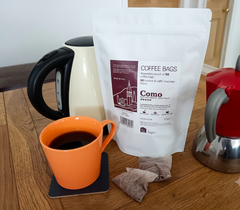
A coffee bag – on the other hand - is freshly ground coffee — the same coffee you'd spoon into a cafetière or moka pot — portioned into a filter bag instead of a tin. Nothing is dissolved, dried, or reconstituted. You're steeping 100% freshly ground coffee in the same way you would with a teabag.
So Where Does the "Weak" Idea Come From?
Partly from the instant-coffee association above, and partly because a lot of coffee bags on the market end up being mild, as they depend ultimately on the amount of water you pour and on the time you let the coffee brew. That's the gap Como was built for: a dark, bold roast in bag format, for people who want intensity without needing a coffee machine to get it.
Coffee Bags vs. Pod Machines
Pod and capsule machines solve a different problem than coffee bags do. They're genuinely good at consistency and speed — but they come with a machine to buy, descale, and eventually replace; proprietary capsules you're tied to and often need to recycle or throw away; and a fixed spot on the counter they occupy permanently.".
A coffee bag needs none of that. No machine, no descaling, no capacity limit beyond how many bags you're carrying. Drop it in a cup, add hot water, done — at a desk, in a hotel room, on a train, wherever hot water exists. That's not a downgrade from a pod machine; it's a different trade entirely, and for many everyday situations, the simpler one wins.
Freshness Is the Real Differentiator
The thing that actually separates a good coffee bag from capsules and instant coffee is freshness, and you notice the aroma as soon as you open a pouch and smell the coffee bag, releasing the true notes of the coffee.
As ground coffee starts losing aroma quickly once exposed to air, packaging matters as much as the roast itself. Our bags are sealed in a resealable pouch with a one-way valve, so the coffee releases its own gas without letting air back in — the same principle we use for our bagged whole-bean coffee and ground coffee.
Get that right, and a coffee bag holds onto real aroma, a longer finish, and the sensory character you'd expect from properly brewed coffee — not the flattened, one-note profile instant coffee is known for.
Where This Actually Matters
This format earns its keep in the situations where a machine simply isn't an option: working remotely away from your usual setup, travelling, camping, or anywhere hot water is available but a coffee machine isn't. It's also the practical choice for an office kitchen that doesn't want to maintain a machine at all.
Try It Yourself
If you've written coffee bags off as a compromise between strength and practicality, it's worth trying Si Sogno Como, our dark roast, bold enough for moka-pot strength; that’s a good place to start
Search
Archive
- April 2024
- September 2023
Recent Post

Custom Menu
FROM_JS
jsprice
jsprice
FROM_JS
FROM_JS
Add to cart
Added
Limit Products
Wait..
Translation missing: en.general.search.loading