Your cart is empty now.


Grinding for Extraction: How Grind Size Changes the Taste of Your Coffee
- 11 November, 2026
- Luca, Si Sogno Coffee
Two people can brew the same coffee and get two completely different cups. One possible culprit: the grind.
Grind size is the quickest way to change how a coffee tastes, and it works the same whether you're pulling an espresso, filling a moka pot or making filter coffee. This coffee grind size guide explains what grind actually does, which size suits which method, and how to read your cup when something tastes off.
How Grind Size Drives Extraction
Brewing is extraction: hot water pulls flavour out of the ground coffee, and grind size controls how fast that happens. Finer grounds expose more surface area and slow the water down, so more is extracted. Coarser grounds do the opposite: the water passes through quickly and takes less.
Too little extraction (under-extraction) and the cup tastes sour, thin and sharp. Too much (over-extraction) and it turns bitter, harsh and dry. The right grind for your method is the one that lands between the two.
Espresso adds one more effect: crema. That golden layer on top forms when water is forced through a fine grind under high pressure, releasing the coffee's oils and emulsifying them with the gas trapped in freshly roasted beans into a fine foam. A fine grind, pressure and fresh coffee all have to work together, which is why crema is a useful early warning when something is off with the grind.
Coffee Grind Size Guide by Brewing Method

Espresso: fine. Think table salt, or finer. Espresso gives the water only 25 to 30 seconds, so the coffee must be fine enough to create resistance under pressure and extract fully in that short time. It is also the least forgiving method: a small change in grind makes a big difference in the cup.
Moka pot: medium-fine. A little coarser than espresso, somewhere between table salt and sand. A moka pot works at much lower pressure, so a true espresso grind may clog it or over-extract into bitterness. Fill the basket level and don't tamp.
Filter and pour-over: medium. Closer to coarse sand. The water drips through under gravity and takes two to four minutes, so the grounds can be coarser without under-extracting. Go too fine and the water slows down, giving a bitter, muddy cup.
Coffee bags: already decided. With a coffee bag the grind choice is made for you. The coffee is ground and portioned for perfect steeping, so there is nothing to adjust and no grinder to clean. For a stronger, bolder taste, just steep the coffee bag for longer.
What's the Best Coffee Grind?
There isn't one best coffee grind, only the best grind for your method and your taste. A few habits help whichever you use:
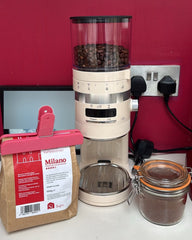
Grind just before brewing. Ground coffee loses aroma much faster than whole roasted beans. Once ground, use it quickly.
Use a burr grinder if you can. It produces more even particles than a blade grinder, and even particles extract evenly.
Buying pre-ground? Tell the roaster or shop which method you use, so the grind is matched to it.
Change one thing at a time. Adjust the grind a small step, taste, then decide.
Troubleshooting: Read the Cup
Your cup tells you what to change:
Sour, thin or sharp: under-extracted. Grind finer.
Bitter, harsh or dry: over-extracted. Grind coarser.
Espresso with little or no crema: the grind may be too coarse, letting water run through too fast to build the foam. Stale coffee can also cause it, so check the coffee is fresh.
Espresso dripping slowly and tasting bitter: the grind is too fine.
Moka pot spluttering or tasting burnt: grind too fine, or heat too high.
Same Craft, Whatever the Method
Grind is one part of a good cup. The other is the coffee itself. Our Milano and Venezia blends are roasted by a family roasting house near Milan, and Como brings a darker, bolder profile to the range. Whichever blend and method you choose, start with the grind, change one thing at a time, and trust your taste.
Search
Archive
- September 2026
Recent Post


Custom Menu
FROM_JS
jsprice
jsprice
FROM_JS
FROM_JS
Add to cart
Added
Limit Products
Wait..
Translation missing: en.general.search.loading